










Search has evolved dramatically over the past few years. Ranking on Google’s first page is no longer the only goal for businesses looking to grow online. Today, users search through traditional search engines, AI-powered assistants like ChatGPT, Google AI Overviews, Gemini, and voice assistants such as Siri and Alexa. As a result, digital marketers must optimize content for multiple search experiences instead of relying solely on traditional Search Engine Optimization (SEO).
This shift has introduced two new optimization strategies: Answer Engine Optimization (AEO) and Generative Engine Optimization (GEO). While SEO helps your website rank in search engine results, AEO focuses on providing direct answers to user queries, and GEO helps your content become a trusted source for AI-powered search engines and generative AI platforms.
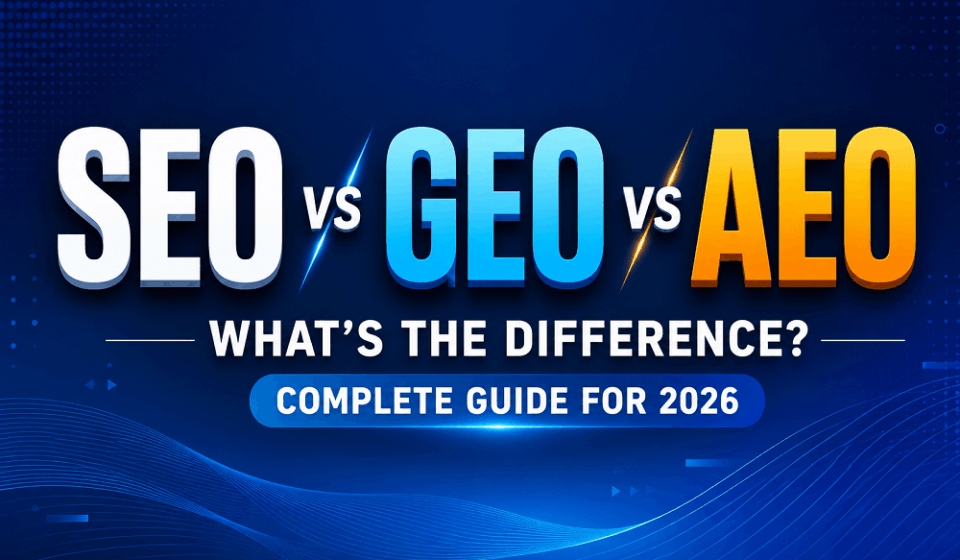
Understanding the difference between SEO vs GEO vs AEO is essential for businesses that want to remain competitive in 2026. In this guide, we’ll explain each strategy, compare their benefits, and show you how they work together to improve your online visibility.
What is SEO (Search Engine Optimization)?
Search Engine Optimization (SEO) is the process of improving a website’s visibility in search engine results pages (SERPs). The goal is to attract organic traffic by optimizing website content, technical performance, and overall user experience.
Traditional SEO involves keyword research, high-quality content creation, technical optimization, backlink building, internal linking, mobile responsiveness, page speed improvements, and structured metadata. Search engines like Google evaluate hundreds of ranking factors to determine which pages deserve higher positions.
For example, if someone searches for “best digital marketing agency”, SEO helps your website appear among the top organic search results.
Key Benefits of SEO
- Increases organic website traffic
- Improves keyword rankings
- Builds website authority and trust
- Generates long-term leads
- Enhances user experience
- Delivers sustainable ROI
Even in the age of AI, SEO remains the foundation of digital marketing because search engines still rely on well-optimized websites to discover and rank quality content.
What is AEO (Answer Engine Optimization)?
Answer Engine Optimization (AEO) focuses on optimizing content so search engines and AI assistants can provide direct answers to users’ questions. Instead of encouraging users to browse multiple web pages, answer engines aim to deliver quick, accurate, and conversational responses.
AEO is becoming increasingly important because users now ask complete questions such as:
- What is SEO?
- How does GEO work?
- Which is better, SEO or AEO?
To improve your chances of appearing in AI-generated answers or featured snippets, your content should answer these questions clearly and directly.
Best Practices for AEO
- Write question-based headings.
- Add detailed FAQ sections.
- Use concise and easy-to-understand answers.
- Implement Schema Markup.
- Organize content using headings, bullet points, and tables.
- Focus on user intent rather than keyword stuffing.
Businesses that optimize for AEO are more likely to appear in Google AI Overviews, featured snippets, voice search results, and AI assistants.
What is GEO (Generative Engine Optimization)?
Generative Engine Optimization (GEO) is a newer digital marketing strategy designed for AI-powered search experiences. Instead of simply ranking on search engines, GEO helps your content become a trusted source that generative AI platforms reference when creating answers.
AI tools like ChatGPT, Gemini, Claude, and Perplexity summarize information from authoritative, well-structured sources. If your content demonstrates expertise, accuracy, and credibility, it has a better chance of influencing AI-generated responses.
Unlike traditional SEO, GEO prioritizes content quality over keyword density. Original research, expert insights, real examples, and updated information play a much bigger role.
How to Improve GEO
- Publish original and valuable content.
- Demonstrate Experience, Expertise, Authoritativeness, and Trustworthiness (EEAT).
- Keep articles updated regularly.
- Use clear headings and logical structure.
- Include real examples, statistics, and case studies.
- Build your brand authority across multiple platforms.
As AI search becomes more popular, GEO will become an essential strategy for businesses that want to remain visible online.
SEO vs GEO vs AEO: Key Differences
| Feature | SEO | AEO | GEO |
|---|---|---|---|
| Primary Goal | Rank on search engines | Provide direct answers | Become a trusted AI source |
| Focus | Organic rankings | Featured snippets & AI answers | AI-generated search experiences |
| Target Platforms | Google, Bing | Google AI, Voice Search | ChatGPT, Gemini, Perplexity, AI Search |
| Content Style | Keyword optimized | Question-answer format | Expert, trustworthy, in-depth content |
| Success Metric | Rankings & Traffic | Answer visibility | AI citations & brand authority |
Although each strategy has a different purpose, they work best when combined.
Which Strategy Should You Choose?
The answer is simple: Don’t choose just one.
SEO, AEO, and GEO complement each other and should be part of the same digital marketing strategy.
- Use SEO to improve your website’s rankings and attract organic visitors.
- Use AEO to answer user questions and appear in AI-powered search results.
- Use GEO to establish your brand as a trusted source for generative AI platforms.
Businesses that integrate all three strategies are better positioned to reach customers regardless of how they search for information.
Best Practices for SEO, GEO & AEO in 2026
To succeed in modern search, businesses should focus on creating content that is useful for both people and AI systems.
- Publish original, helpful, and well-researched content.
- Use descriptive headings and logical content structure.
- Optimize pages for Core Web Vitals and mobile devices.
- Answer common customer questions naturally.
- Add FAQ and structured data where relevant.
- Build high-quality backlinks from trusted websites.
- Update older articles regularly with fresh information.
- Demonstrate expertise through real examples and case studies.
- Improve brand authority by publishing consistently across multiple channels.
Following these best practices will improve your visibility across traditional search engines, AI assistants, and generative search platforms.
Frequently Asked Questions
Is GEO replacing SEO?
No. GEO is not replacing SEO. Instead, it complements traditional SEO by helping content appear in AI-generated search experiences.
Can SEO and AEO work together?
Yes. A well-optimized SEO page that includes clear answers, FAQs, and structured content is also more likely to perform well for AEO.
Why is GEO important in 2026?
As more users rely on AI-powered search tools, businesses need content that AI systems trust and reference. GEO helps improve visibility in these emerging search experiences.
Which is more important: SEO, GEO, or AEO?
All three are important. SEO drives organic traffic, AEO improves answer visibility, and GEO increases your chances of being referenced by AI platforms.
The future of search is no longer limited to traditional search engine rankings. Users now expect instant answers, personalized experiences, and AI-generated recommendations. That’s why businesses must move beyond conventional SEO and embrace Answer Engine Optimization (AEO) and Generative Engine Optimization (GEO).
Rather than viewing these strategies as competitors, think of them as complementary parts of a modern digital marketing plan. SEO helps users discover your website, AEO helps your content answer their questions, and GEO positions your brand as a trusted source for AI-powered search.
By investing in all three strategies, businesses can improve search visibility, build credibility, attract more qualified traffic, and stay ahead in the rapidly evolving digital landscape of 2026 and beyond.
