









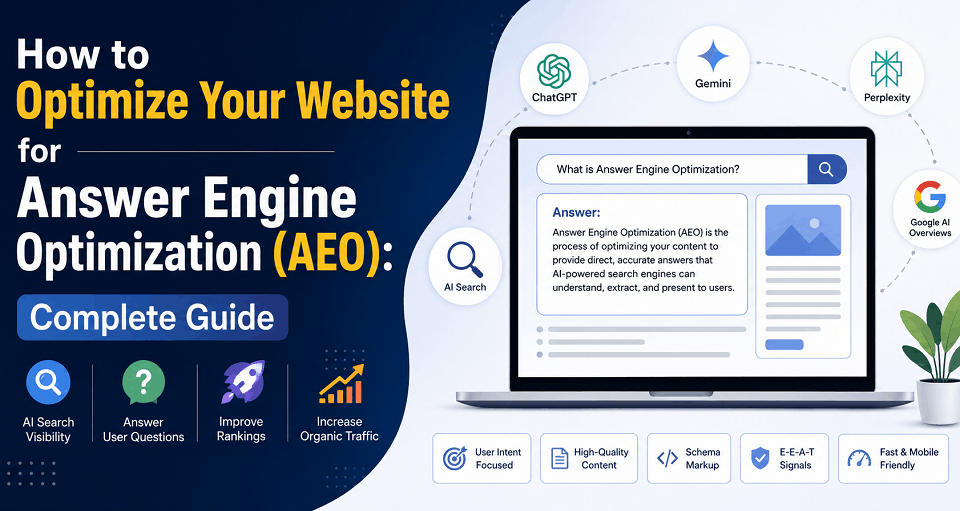
How to Optimize Your Website for Answer Engine Optimization (AEO): A Complete Guide for Better AI Search Visibility

Search is changing rapidly. Traditional search engine optimization (SEO) is no longer the only way users discover information online. AI-powered platforms such as Google AI Overviews, ChatGPT, Gemini, Perplexity AI, and Microsoft Copilot are increasingly providing direct answers instead of simply listing webpages.
This shift has made Answer Engine Optimization (AEO) an essential part of a modern digital marketing strategy.
If you want your website to be cited by AI-powered search tools, featured in AI-generated answers, and continue attracting high-quality organic traffic, this guide explains how to optimize your website for AEO while strengthening both your SEO and Generative Engine Optimization (GEO) performance.
What Is Answer Engine Optimization (AEO)?
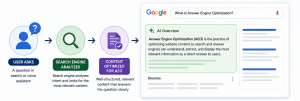
Answer Engine Optimization (AEO) is the process of creating and structuring website content so AI-powered search engines can easily understand, extract, and present it as direct answers to users.
Unlike traditional SEO, which primarily focuses on rankings, AEO focuses on becoming the best answer to a user’s question.
When your content clearly answers search intent, AI platforms are more likely to reference your website in their responses.
Why AEO Matters in 2026
Millions of users now ask AI assistants questions like:
- What is Answer Engine Optimization?
- How do I improve website rankings?
- Best SEO strategies for small businesses
- How does Google AI Overview work?
Instead of displaying ten blue links, AI engines summarize information from trusted, authoritative websites.
Optimizing for AEO helps your website:
- Increase visibility in AI-generated answers
- Improve brand authority
- Gain qualified organic traffic
- Earn featured snippets
- Support SEO and GEO performance
- Prepare for the future of search
Step 1: Understand User Search Intent
Every piece of content should answer a specific question.
Examples include:
- What is AEO?
- Why is AEO important?
- How can I optimize my website?
- What tools help with AEO?
Create content around real user questions instead of only targeting keywords.
Step 2: Write Direct, Clear Answers
AI models prefer content that provides immediate value.
Instead of lengthy introductions, answer the question within the first few sentences.
Example:
Question: What is AEO?
Good Answer:
Answer Engine Optimization (AEO) is the process of optimizing website content so AI-powered search engines can understand, summarize, and display accurate answers directly to users.
After the concise definition, expand with additional details.
Step 3: Structure Content Properly
Well-structured content is easier for AI systems to understand.
Use:
- H1 for the main topic
- H2 for major sections
- H3 for supporting information
- Short paragraphs
- Bullet points
- Numbered lists
- Tables where appropriate
This structure improves readability for both users and AI models.
Step 4: Use Question-Based Headings
AI search platforms often look for content that directly answers questions.
Examples:
What Is Answer Engine Optimization?
Why Is AEO Important?
How Does AEO Work?
What Are the Benefits of AEO?
How Can Small Businesses Implement AEO?
Question-style headings increase the chances of being selected for AI-generated responses.
Step 5: Build Comprehensive Topical Authority
Publishing one article is not enough.
Create an interconnected content cluster covering:
- What is AEO?
- AEO vs SEO
- AEO vs GEO
- AI Search Optimization
- Schema Markup
- Google AI Overview
- ChatGPT Search Optimization
- Perplexity SEO
- AI Content Optimization
- Voice Search Optimization
Internal links between related articles help search engines and AI understand your expertise.
Step 6: Add Schema Markup
Structured data provides additional context.
Important schema types include:
- FAQ Schema
- Article Schema
- Organization Schema
- WebPage Schema
- Breadcrumb Schema
- Author Schema
- HowTo Schema (where appropriate)
Schema improves content understanding and eligibility for rich search features.
Step 7: Demonstrate Experience, Expertise, Authoritativeness, and Trust (E-E-A-T)
AI systems prefer trustworthy sources.
Strengthen credibility by including:
- Detailed author profiles
- Professional credentials
- Reliable references
- Updated publication dates
- Contact information
- About Us page
- Editorial policy
- Privacy policy
Trust signals increase the likelihood of AI platforms referencing your content.
Step 8: Optimize for Featured Snippets
Featured snippets often become sources for AI-generated answers.
Best practices:
- Define concepts clearly
- Use concise paragraphs (40–60 words)
- Create comparison tables
- Include ordered and unordered lists
- Answer questions directly
Step 9: Improve Website Performance
Fast websites provide a better user experience.
Focus on:
- Core Web Vitals
- Mobile responsiveness
- HTTPS
- Fast loading times
- Image optimization
- Clean URLs
- Crawlability
Technical SEO remains an important foundation for AEO.
Step 10: Create AI-Friendly FAQs
Frequently Asked Questions are valuable for both users and AI systems.
Example:
What is AEO?
Answer Engine Optimization helps AI-powered search engines understand and display your content as direct answers.
Is AEO replacing SEO?
No. AEO complements SEO. Both should be part of a comprehensive digital strategy.
Does schema improve AEO?
Schema helps search engines understand webpage content and can improve eligibility for enhanced search results.
Step 11: Use Semantic Keywords
Instead of repeating the same keyword, naturally include related terms such as:
- AI Search
- Google AI Overviews
- ChatGPT Search
- AI Assistants
- Large Language Models (LLMs)
- Search Intent
- Structured Data
- Entity SEO
- Semantic Search
- Natural Language Processing (NLP)
- Voice Search
- Information Retrieval
Semantic relevance helps AI better understand the topic.
Step 12: Keep Content Updated
AI systems favor current, accurate information.
Regularly:
- Refresh statistics
- Update screenshots
- Add new AI platforms
- Expand FAQs
- Improve examples
- Address recent developments
Fresh content signals ongoing expertise.
Common AEO Mistakes to Avoid
Avoid these issues:
- Keyword stuffing
- Thin content
- Missing schema markup
- Poor website speed
- Lack of internal links
- Ignoring user intent
- Duplicate content
- Outdated information
- Weak author credibility
- No FAQ section
Best Practices Checklist
✔ Answer the primary question immediately.
✔ Match content to user search intent.
✔ Use descriptive headings and subheadings.
✔ Include FAQ, Article, and Organization schema.
✔ Publish comprehensive, authoritative content.
✔ Link related articles together.
✔ Optimize for mobile and Core Web Vitals.
✔ Build E-E-A-T with author information and trust pages.
✔ Update content regularly with new information.
✔ Monitor performance in Google Search Console and analytics tools.
Conclusion
Answer Engine Optimization is becoming a critical component of online visibility as AI-powered search continues to evolve. While SEO remains essential for search rankings, AEO focuses on making your content understandable, trustworthy, and easy for AI systems to reference in direct answers.
The most effective approach is to combine SEO, AEO, and Generative Engine Optimization (GEO). Create content that genuinely answers users’ questions, organize it with a clear structure, support it with schema markup, demonstrate expertise through E-E-A-T, and maintain high technical standards. Websites that consistently publish accurate, user-focused content are better positioned to earn visibility in both traditional search results and AI-generated responses.
